Counterfactual Complexities
Lessons learned in US steel slag markets


What is a counterfactual?
In carbon dioxide removal (CDR), the counterfactual refers to what would have happened in the absence of a given CDR project happening. For instance, if project X was never initiated what would have the materials been used for? Would any carbon have been removed from the atmosphere anyways? Would any carbon have been emitted?
For a CDR project to achieve net removal of CO2 from the atmosphere, the project needs to remove more CO2 than the project emits, as well as any CO2 removal associated with the counterfactual scenario. A simplified accounting framework might look like this:
Net CDR = Gross CDR – Process Emissions – Counterfactual CDR
Gross CDR is the total amount of CO2 removed from the atmosphere by a project. Process emissions generally include anything directly required to build a project, like transporting feedstocks, crushing to a finer grainsize, or the embodied emissions of capital equipment used for the project. Counterfactual CDR varies depending on the type of project – how would steel slag be used, what happens to that waste biomass, or would that rock be mined?
Steel slag as a feedstock
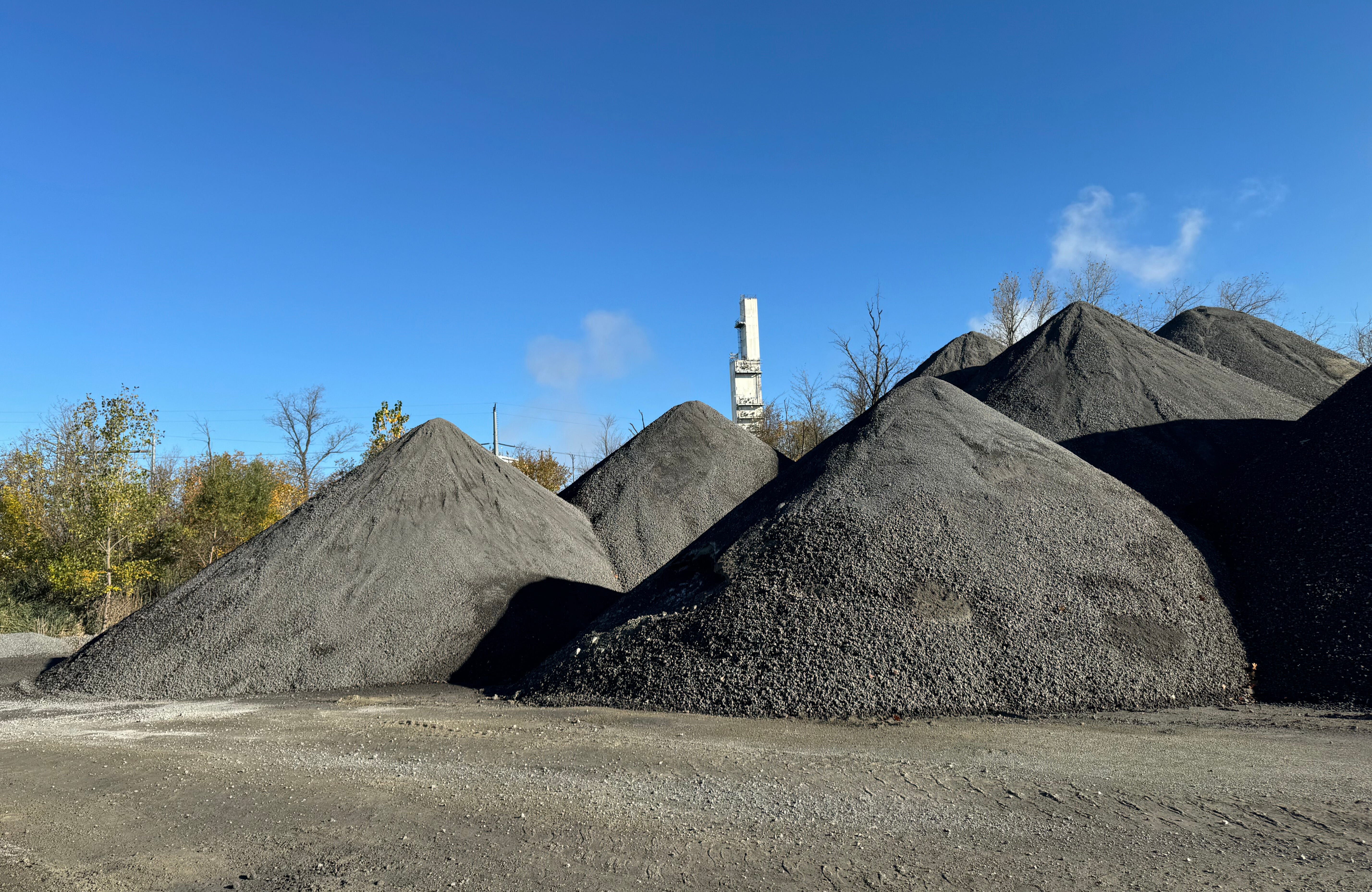
Our work with steel slag primarily focused on electric arc furnace (EAF) and ladle metallurgy furnace (LMF) slags generated in the United States at mini-mills where scrap metal is recycled into steel. As we described in our last post, we set out to deliver CDR by optimizing the use of steel slag as gravel products in surfaces like roads and parking lots. EAF and LMF slags are blended into aggregate products for these types of unconfined applications and deployed in many U.S. markets. We spent a significant amount of time working to optimize CDR in these types of settings.
One of the first things we learned about steel slag is that it is remarkably reactive with CO2, making it one of the most attractive feedstocks to pursue for CDR. LMF slags, in particular, are rich in calcium oxide and hydroxide phases that readily react with CO2 to form new carbonate minerals. This happens naturally any time slag is exposed to CO2 and humidity, whether in a stockpile, a gravel road, or a bucket in the lab. For CDR project developers, utilizing steel slag as a feedstock requires pushing the CDR for a unit of feedstock beyond the natural reactivity of the material. A first step in constraining counterfactual CDR for steel slag, then, is understanding what would have happened to the feedstock if it wasn’t used in a CDR project.
In some academic literature the perception is that most steel slag is a waste product stored unused in stockpiles or landfills. In the United States this is simply not true. Our understanding after three years of visiting steel mills, talking with material experts, and evaluating local markets is that steel slag is generally repurposed into construction markets. The local market around each mill dictates exactly what the uses are, but steels slags are variably used in aggregate blends, as filler in concrete and asphalt, as substitutes for cement, and sometimes recycled back into the steel making process. While there is a well-functioning industry built around steel slag, occasionally some slags do accumulate in large stockpiles.
Counterfactual scenarios
Our work focused on constraining two counterfactual scenarios that cover the majority of EAF and LMF slag usage, (1) stockpiled material on site at a steel mill or landfill and (2) used as gravel aggregate in unconfined, open-air settings.
In general, we found that stockpiles varied in age, size, composition, and exposure history. In an ideal counterfactual world, stockpiles would continually accumulate with homogenous slag and never be disturbed. If that were the case, simple geochemical characterization of the feedstock would allow us to quickly constrain the CDR counterfactual. Unfortunately, we’ve found that reality is far from ideal.
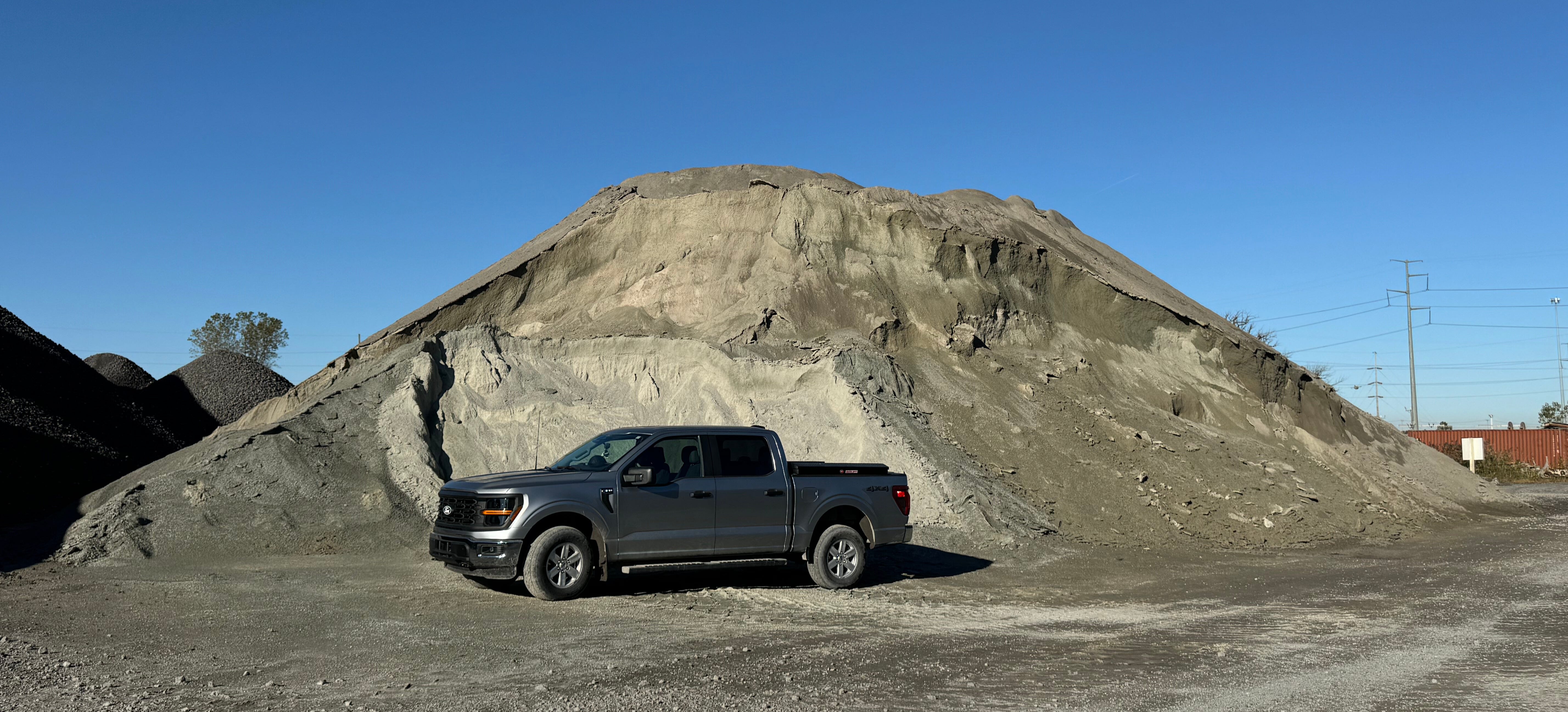
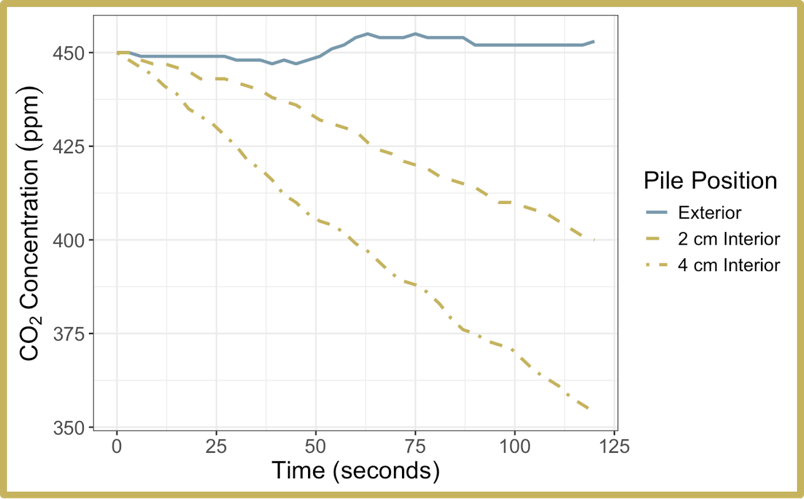
When steel slag, particularly LMF, is initially stockpiled, the material on the exterior surface reacts to form a cemented crust about 2-5 cm thick. This crust is the result of carbonate minerals welding together the pieces of steel slag aggregate. See our previous post for an overview of the carbon mineralization process. The crust is relatively impermeable, limiting active CO2 drawdown and mineralization in the pile interior. Gas flux measurements of crusted stockpiles show no active CDR on the surface, however, after digging ~2-4 cm through the crust into the interior material actively mineralizes CO2. On the one hand, this is great news: stockpiled material doesn’t react much beside the thin crust on the surface. Yet, this effect doesn’t hold up in that case that a pile is disturbed, excavated, or moved – freshly exposed slag will react to create new carbonate crusts.
Across the US, we found that most EAF and LMF slag piles are actively managed. They are temporary features of steel mill facilities. Slag processing companies excavate and often sell stockpiles over the course of months to years. Even long-lived piles have questionable stability and homogeneity. Anecdotally we knew of an LMF pile that had been on-site for ~14 years, however, timelapse satellite imagery showed that the entire pile had been moved multiple times. We also heard stories of decades old piles littered with scrap metal, cars, and boats. The active processing continually exposes fresh slag, drives mineralization reactions, reduces homogeneity, and increases the counterfactual CDR for slag stockpiles.
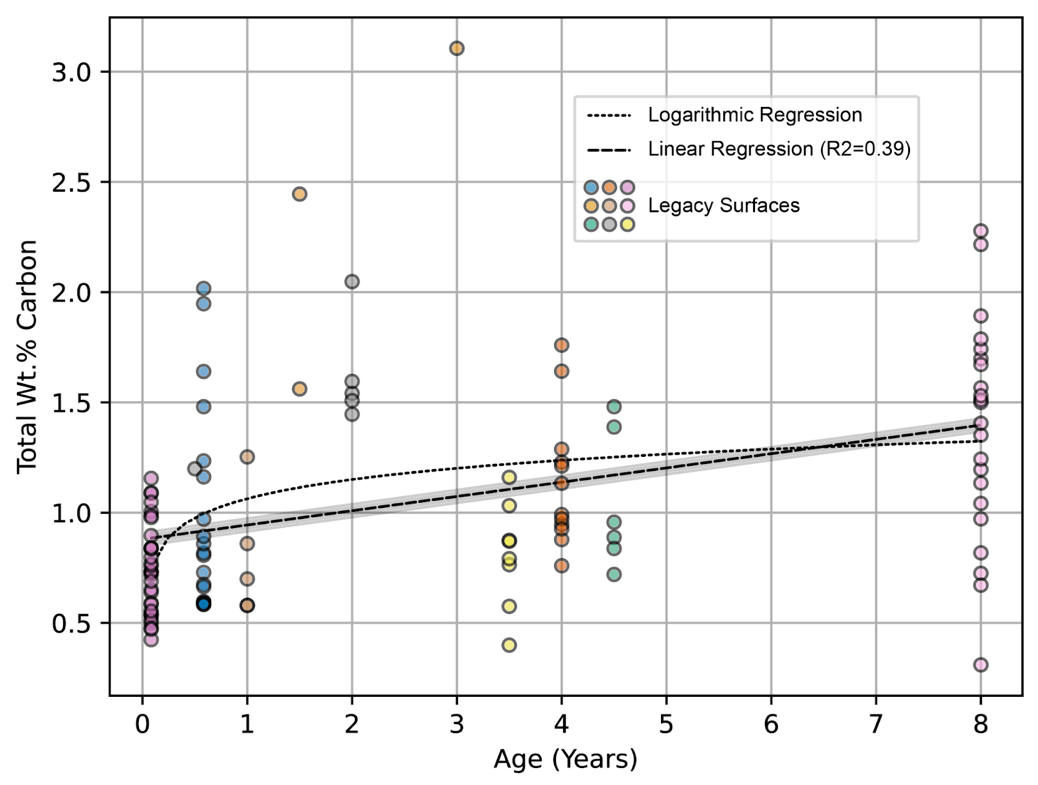
Most stockpiled EAF and LMF in the US is eventually used as blended aggregate for roads or parking lots. By sampling many aged surfaces, we learned that the gravel road counterfactual CDR is highly variable. Solid phase total carbon measurements showed large differences within single sites, across sites of similar ages, and across time. Gas flux dynamics pointed to a marked decrease in the reaction rate over time, where the interior of the surface eventually passivates to the same extent as the exterior. This variability may be explained by material heterogeneity, climate, vehicle traffic, gravel deployment geometry, or any other project externality. Lacking much of this initial data for the old projects, we were unable build a clear mineralization model for roads. Considering the data, a conservative counterfactual approach suggests that the surfaces of the aggregate will thoroughly mineralize over time.
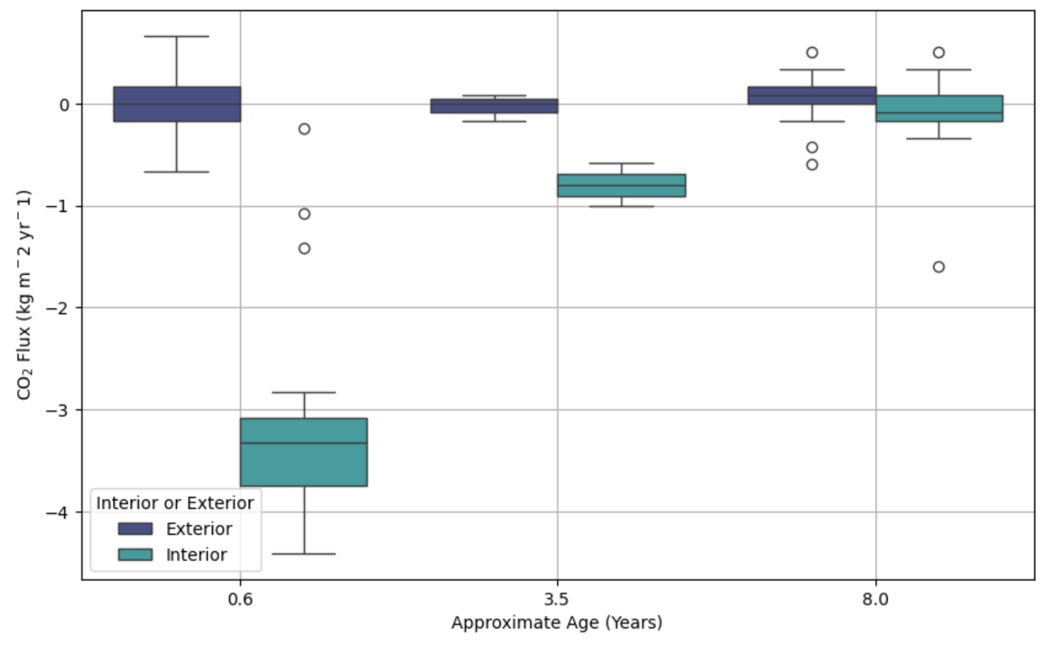
Essentially, our field work led us to believe that steel slag exposed to CO2 and water, whether in a stockpile or a road, will eventually achieve the same degree of carbonation.
The thousand-year problem:
Registry protocols tend to treat counterfactual timescales differently. Ultimately, projecting what a feedstock will be used for over the next 100-1,000 years is hard. For a quarried feedstock, perhaps it is safe to assume that the material may stay in the ground without a given CDR project. For industrial feedstocks like steel slag, it is conservative and reasonable to assume the material will be used or landfilled. Presuming that a pile would sit stable and unreacted for 100 to 1,000 years is unreasonable. And if the material is going to be moved, ultimately over those time scales it is most conservative to assume the material will carbonate to the same extent as the pile crusts and road surfaces.
Ultimately, the high counterfactual CDR that we saw in piles and roads makes it difficult to achieve significant net CDR with passive mineralization approaches. Additional interventions (and energy) to decrease the grain size or increase weathering rates are needed to maximize gross CDR.
Closing Thoughts:
US slag markets are active and dynamic. Steel slag generally does not accumulate in static stockpiles. EAF and LMF often find market uses which drive increased mineralization.
Slag material composition and uses are variable. Without substantial historical data to quantify this variability, project developers should tend towards conservative estimates of counterfactual CDR.
Passive mineralization projects using steel slag will be challenged to overcome conservative counterfactuals. Interventions such as initial comminution or material abrasion would increase gross CDR but at the expense of greater project emissions.
Counterfactuals are not an afterthought. They are central to the integrity of CDR claims. Projects that do not explicitly and transparently define their baselines risk losing trust and undermining the field as a whole.
Our next post will detail our exploration into more engineered approaches. We will summarize our learnings associated with building a reactor-based system and the associated operational and technical challenges.
As always, we are happy to chat with anyone who would like to learn more.